What Is a Beta Mom? The Quiet Shift Reshaping What "Doing It All" Means
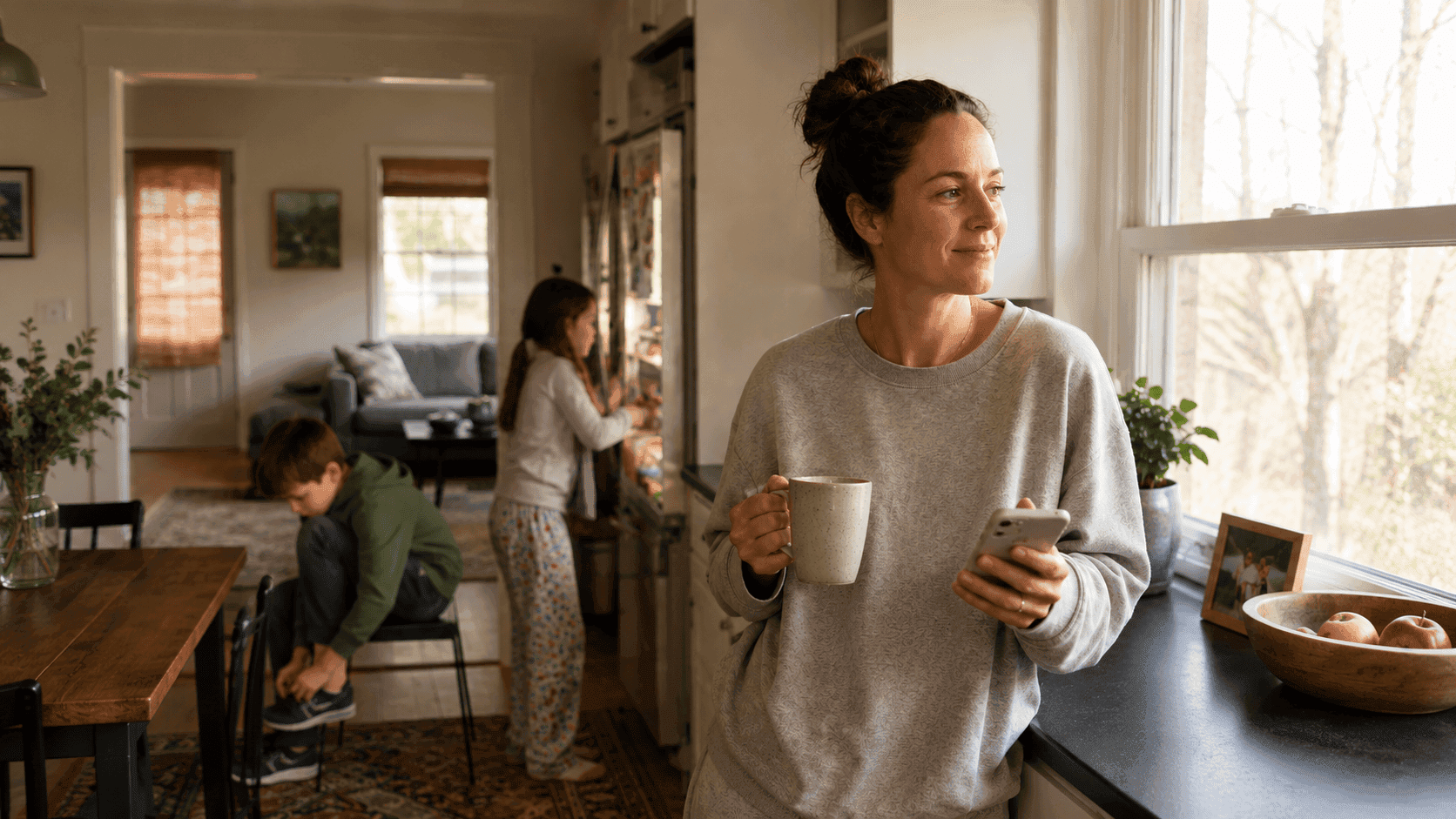
Table of Contents
- A short history of how mothering got this intense
- The math has stopped pretending to work
- The costs we couldn't always see
- Why now: a broader idea of what "preparing your kids" means
- Beta, Type B, Type C; pick your permission slip (or don't pick one at all)
- Whatever your style, the mental load is universal
- A day in the life, for the moms who want it
- What this moment is really about
- FAQ
A new generation of high-achieving mothers is rewriting the rules of intensive parenting and giving every mom more permission to define what works for her family.
Danielle Antosz keeps a wicker basket of unsorted socks by the door. Every morning, her two kids reach in and pull out whatever two they grab. Sometimes a tall sock and a short one. Sometimes a Paw Patrol relic from toddlerhood. "I'm not willing to spend my time sorting socks," she told the Wall Street Journal in a recent piece on the rise of the beta mom.
Three decades ago, that quote might have read as a confession. Today, the WSJ frames it as part of a quiet feminist shift, low-key but real.
After thirty years of escalating expectations around what high-achieving mothers should be doing, for their careers, their children, their homes, and their own self-improvement, the Wall Street Journal recently named a quiet cultural shift: the rise of the beta mom. She's reclaiming date night. She's saying no to the seventeenth after-school activity. She's making peace with dirty dishes in the sink.
But this isn't really a story about one camp winning over another. It's a story about the band of acceptable mothering finally widening, and about the mothers, of every style, who are choosing what fits their family instead of what fits the prevailing expectation.
A short history of how mothering got this intense
Mothers have always done the bulk of household and child-rearing work. What changed in the 1990s, the WSJ notes, is that "mothers were also expected to be project managers for their kids' futures."
Economists trace the shift to widening inequality and the rise of the knowledge economy, which created a profound anxiety in parents who feared they would fail if they didn't ensure their children had a competitive edge. Parents, especially mothers, were responding to a real and rational anxiety: that any child without a competitive edge might fall behind permanently. Enrichment classes, travel teams, exclusive preschools, college-resume engineering, even (per the WSJ's tartest line) parents quietly finishing their kids' Girl Scout Gold Award projects so the kids could list them on applications. All of it became the new baseline of "good parenting." Amy Chua's 2011 book, Battle Hymn of the Tiger Mother, gave the era its anthem.
Then, in the last decade, the load doubled. The rise of gentle parenting added what the WSJ called "emotional complexity to this labor." Suddenly it wasn't enough to optimize a child's chances. Mothers were also expected to model calm self-regulation through every tantrum, every refusal, every meltdown. The job description grew, and the bar for "doing it right" moved with it.
Mothers were now expected to be project managers, trauma-informed therapists, emotional regulators, and curators of developmentally appropriate experiences, all while also potentially maintaining a career.
And here's the part worth pausing on: mothers showed up for it. They built the systems, scheduled the activities, mastered the gentle-parenting frameworks, and earned the salaries. They met an enormous, escalating ask and met it with extraordinary effort. What's shifting now isn't a verdict on their work. It's a recognition that the ask itself was never sustainable for any one woman to carry alone.
The math has stopped pretending to work
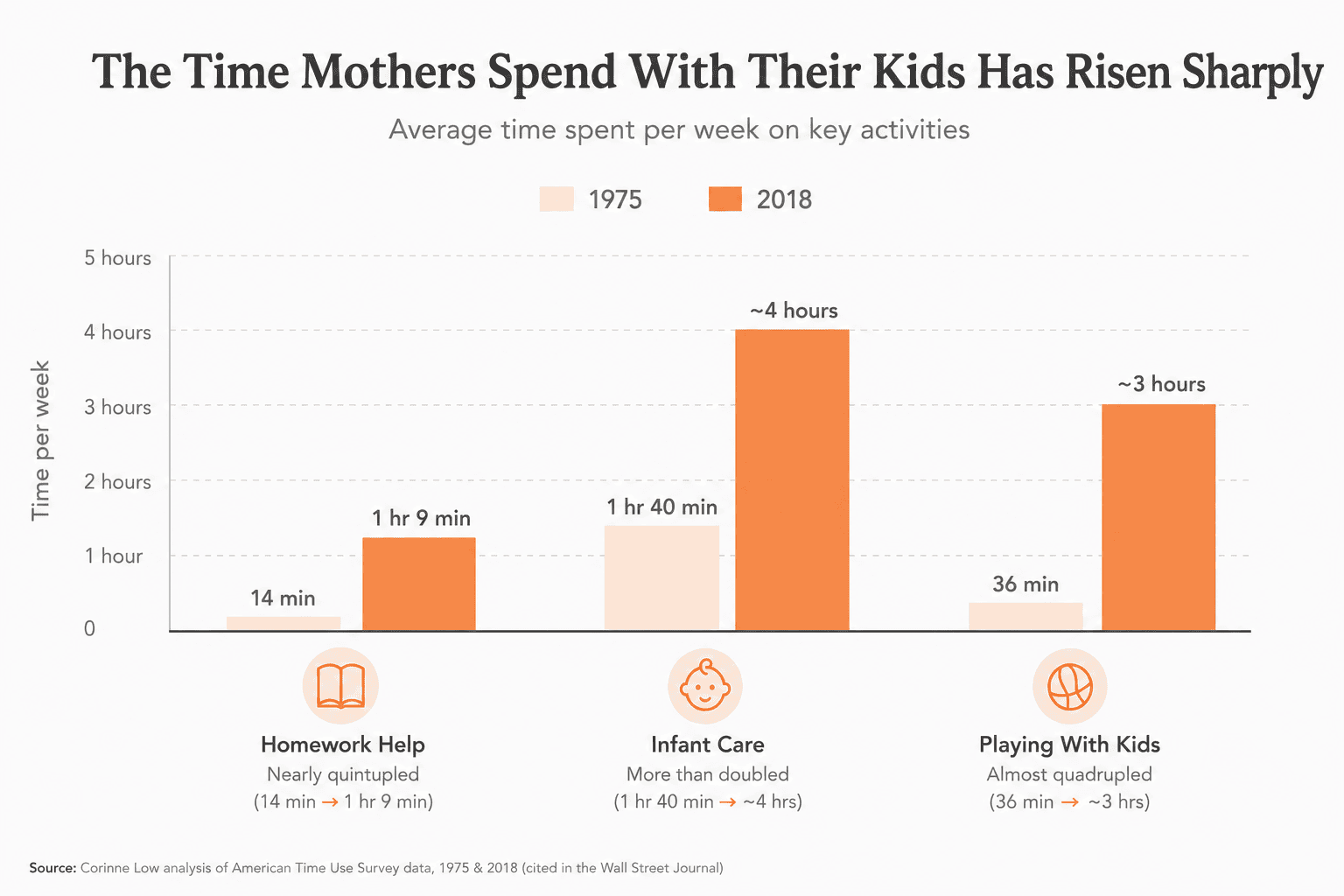
The numbers tell a story the culture has been slow to acknowledge. Maternal labor force participation hit a record 74% between 2023 and 2025. At the same time, the time demands of intensive parenting kept climbing. UPenn economist Corinne Low's analysis of American Time Use Survey data, cited in the WSJ, found that between 1975 and 2018, the time mothers spent helping with homework nearly quintupled, from 14 minutes a week to 1 hour and 9 minutes. Time spent on infant care more than doubled. Time spent playing with kids almost quadrupled.
More women working. More hours expected per child. And, perhaps not coincidentally, fewer children. The U.S. general fertility rate fell again in 2025 to 53.1 births per 1,000 women ages 15 to 44, the lowest in CDC records going back to 1909, and 23% below the 2007 peak. In a recent Brigham Young University survey, 71% of adults disagreed with the idea that having children is affordable for most people.
You don't have to be an economist to see what's happening. The job description for "good mother" kept expanding while the supply of hours in a day did not. Something had to give, and what's given is the assumption that any one woman can absorb the whole thing.
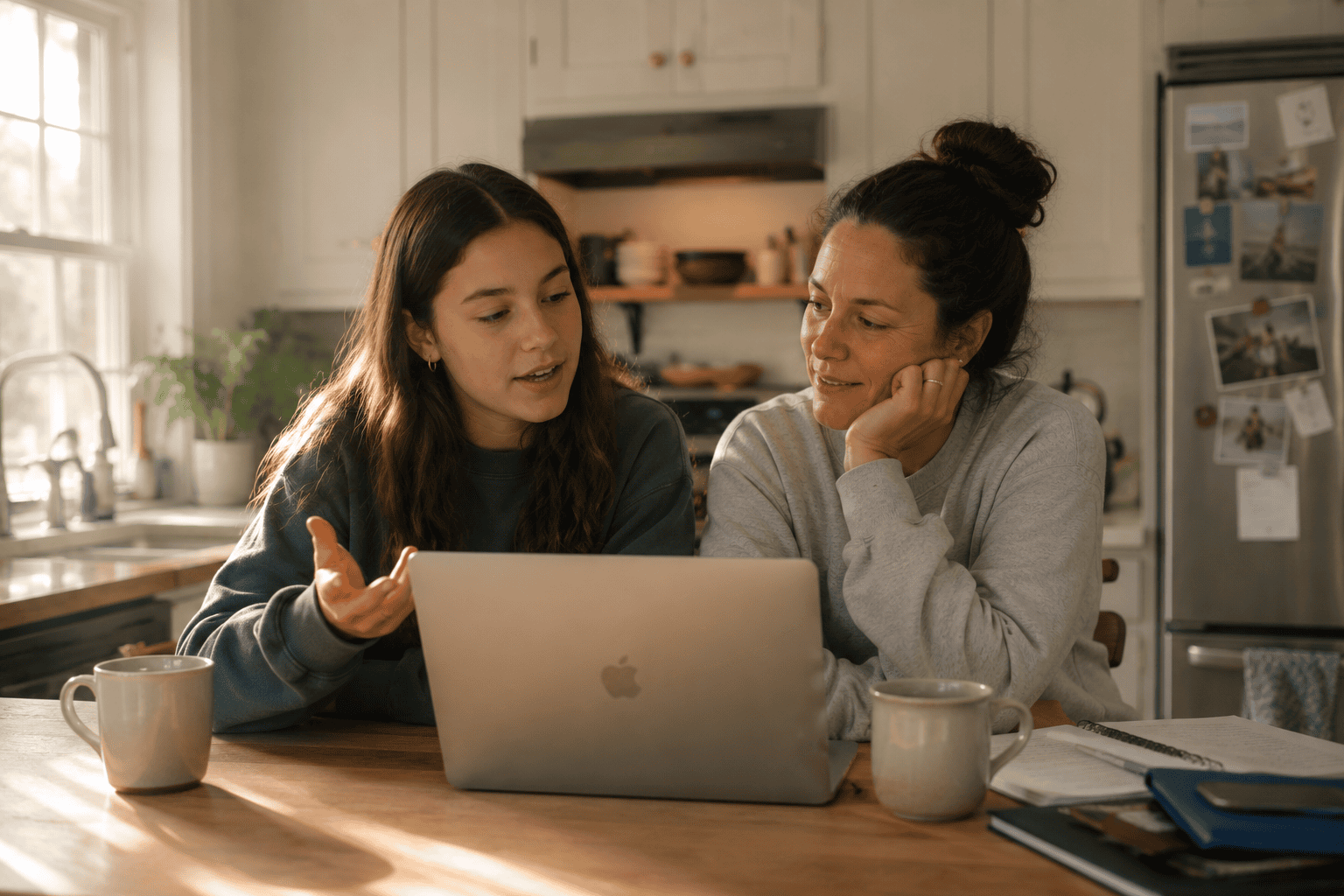
The labor in question isn't only the visible kind. The harder layer, the part that doesn't show up on a time-use survey, is what sociologist Allison Daminger calls cognitive labor: the anticipating, researching, deciding, and monitoring that holds a household together. In her research at the University of Wisconsin-Madison, based on more than 170 interviews with couples, Daminger found that women carry the majority of this work even in relationships that aim to be equal, and disproportionately the most invisible parts of it: scanning the horizon for what's coming, tracking whether things actually got done. As one participant in her research described it, it's "a constant low-grade hum of anxiety." Daminger also found something she didn't expect: women carrying this load reported lower political participation, on top of higher anxiety and burnout. The cost of holding it all isn't only personal. It compounds.
This is the labor underneath the labor. And it's the part that explains why intensive parenting hit a wall even for the women who, by every external measure, were succeeding at it. As Low told the WSJ, "What I see reflected as the accomplishments of kids, I really see as the labor input of parents."
Once you see the work this way, recalibration stops looking like opting out and starts looking like the only honest response to the math.
The costs we couldn't always see
Some of the experts the WSJ spoke with have spent years documenting the price tag attached to the most intensive end of the parenting spectrum.
Claire Nicogossian, a clinical psychologist who works with mothers, has watched this backfire in her practice for two decades. She's seen genuinely talented teenagers, kids ranking in regional athletics or performing with professional symphonies, abruptly quit in their mid-teens. As she told the WSJ, it was often "their only act of self-determination in an otherwise managed life."
Brown University economist Emily Oster put it more diplomatically: "It's a reaction to a trend that has reached its practical limits. Parents are realizing that maybe going to Harvard isn't going to deliver success on a silver platter."
These aren't verdicts on individual mothers. They're observations about a system that asked too much, of both parents and kids, for too long. And they explain why so many high-achieving women, many of whom built their own careers on intensive effort, are now, quietly, rewriting parts of their household rules.
Why now: a broader idea of what "preparing your kids" means
The intensive-parenting playbook was built on a specific model of what success looked like for the next generation: a stable, well-paid, white-collar professional career. AI is shaking that model. The labor market for new graduates is stagnating. Entry-level white-collar work is being automated faster than anyone predicted. The professional class itself is reckoning with what its work will look like in ten years.
None of that means intensive parenting was wrong, then or now. For many families it still is exactly the right approach, particularly for kids who are genuinely thriving in a structured, ambitious environment. What it does mean is that the definition of "preparing your kids for the future" is broadening. Resilience, autonomy, real relationships, mental health, the ability to handle uncertainty and figure things out; these are looking more and more like the durable skills of the next economy. And many of those skills grow in the spaces parents don't fill in.
This is where Ohai's founder Sheila Lirio Marcelo, who built Care.com and is now building Ohai, has been advocating for years that the answer isn't sometimes doing more. It's the harder choice underneath:
"What if the solution isn't just about doing it all? What if part of the solution is deciding that it doesn't all have to be done, freeing yourself to focus on what really matters?"
— Sheila Lirio Marcelo, Founder & CEO, Ohai
What "really matters" looks different for every family. The point isn't to give up. It's to choose with intentionality.
Beta, Type B, Type C; pick your permission slip (or don't pick one at all)
The vocabulary is still catching up to the moment. The WSJ uses "beta mom." TikTok has popularized "Type B mom." Houston content creator Ashleigh Surratt coined "Type C," which she describes as "caring deeply about some things while aggressively letting go of others." (All three of her kids wear the same diaper size, regardless of age, because she's not tracking three different sizes. Bedtime is, in her words, "schmedtime.")
You don't have to pick a label. You don't even have to step back from intensive parenting if it's working for your family. The point of this moment isn't that everyone should become a beta mom. The point is that mothers now have more explicit cultural permission to define what works for them, instead of inheriting a single "right way" from the culture around them.
For Adrian Knowles, a 35-year-old veterinarian raising four kids in Tampa, the calculus is simple. She'll put off laundry to go out to lunch with her sister. She'll spend a spare 30 minutes reading a book instead of cleaning. "I am a better Adrian," she told the WSJ, "who then can be a better mom."
That's the permission slip in one sentence. You are allowed to be a better version of yourself first. Sheila's version of the same idea, sharpened from her own journey of raising her family while building Care.com at the same time:
"When you decide to let go and do less, you give yourself space to be more of who you are."
— Sheila Lirio Marcelo, Founder & CEO, Ohai
Whatever your style, the mental load is universal
Here's the thing about every style of modern mothering (tiger, beta, Type B, Type C, somewhere in between), they all share one invisible burden: the mental load. The cognitive labor of running a household. Whose pediatrician appointment is when. Which kid is allergic to what at which friend's birthday party. What's in the fridge. Whether the cleats are already in the soccer bag.
This load is universal. A tiger mom carries it. A beta mom carries it. A working mom carries it. A stay-at-home mom carries it. If anything, the more intensely you parent, the more of it you carry. The only question is whether it lives entirely inside your own head or whether some of it lives somewhere else.
Sheila puts it this way:
"Every day we carry a burden of thoughts which is equal to the burden of doing."
— Sheila Lirio Marcelo, Founder & CEO, Ohai
The work of choosing your style, whether it's beta, intensive, or anything in between, looks like redistribution. Three buckets to think about, regardless of which kind of mom you are:
1. What gets dropped. The activities, expectations, and traditions that don't actually serve your family. (Jessica Tyson, a Connecticut mom profiled in the WSJ, threw out her zero-sugar baby food recipes after a pandemic-era mental health breakdown and has not looked back.)
2. What gets delegated. Partners, when there's a partner. Kids themselves, who are usually capable of more than we let them do. Tools and services that absorb the project-management layer (the to-dos, the calendar coordination, the reminders). Ohai exists for exactly this layer, surfacing your to-dos, calendar events, and reminders so they live somewhere other than your head, whether you're a deliberately involved parent or a deliberately laid-back one.
3. What gets shared. The cognitive load itself can be pulled out of one person's head and made visible to the people and systems that can help carry it.
A day in the life, for the moms who want it
This isn't the only way to mother. It's one possible Tuesday.
She wakes up to a calendar she didn't have to build from scratch; soccer pickup is on it, the dentist appointment is on it, the school early-release day is on it. She didn't memorize any of it. It just shows up.
She skips packing artisanal lunches. The kids pack their own. The PB&J is fine. Better than fine, it's theirs.
She works without the background hum of "I should also be doing X." She trusts that the X is being tracked somewhere outside her head, and the things that genuinely need her attention will surface when they need her attention.
She picks up the kids. They have unstructured time. They are, briefly, bored. They figure it out.
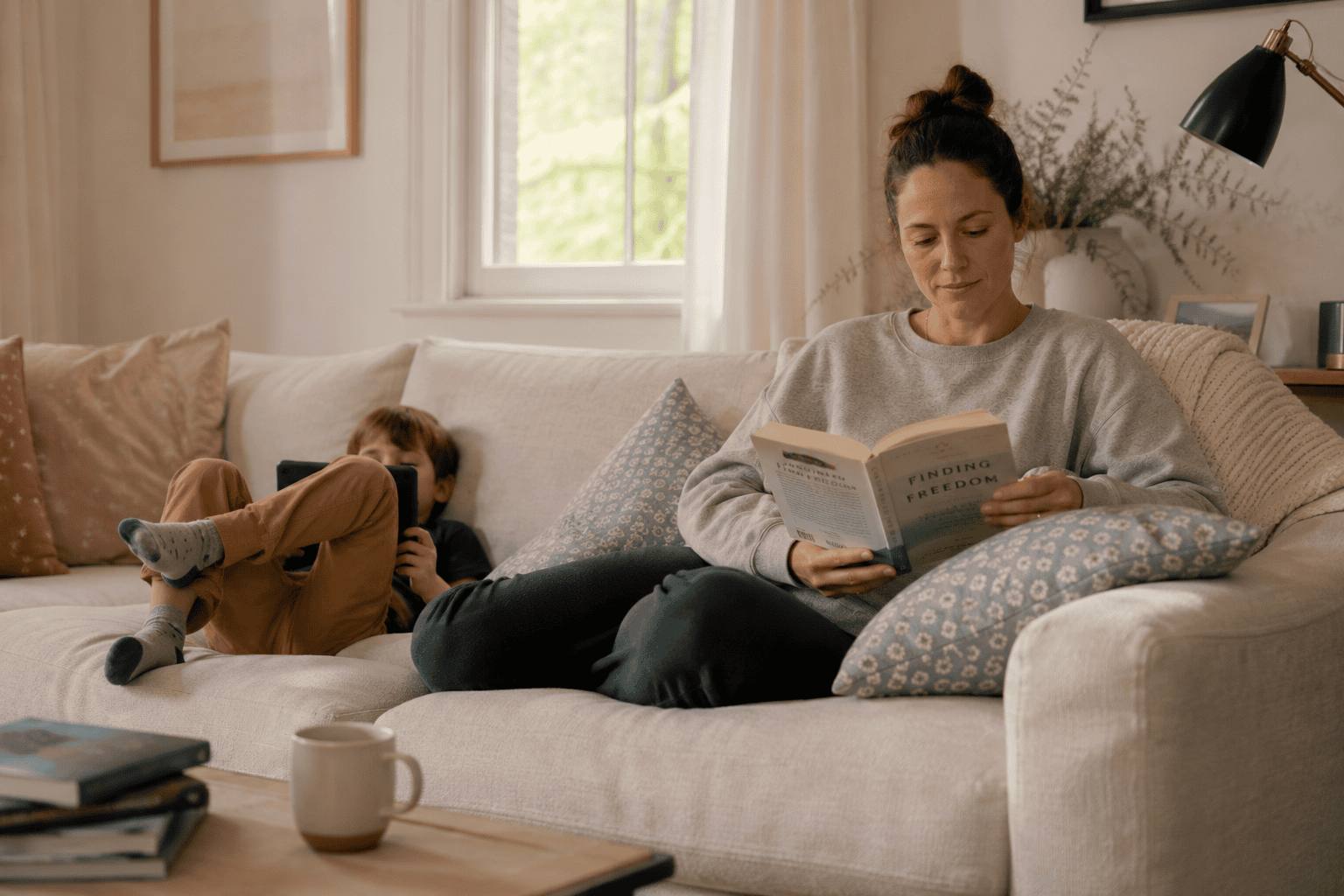
Dinner is simple. Maybe it's leftovers. Maybe it's takeout. Or maybe it's a last-minute brainstorming recipe with Ohai. The dishes go in the sink and stay there until morning.
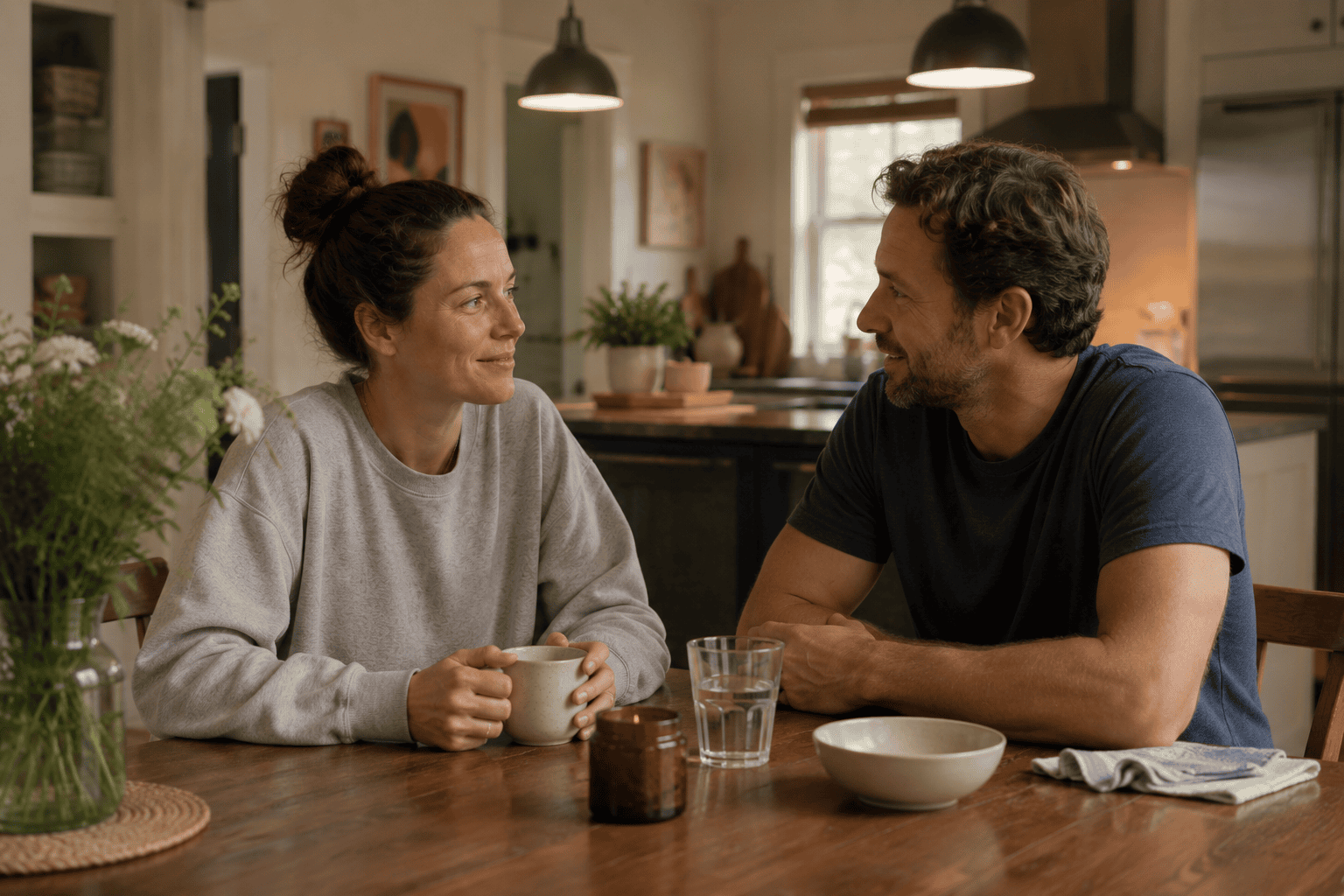
She has a real conversation with her partner that doesn't end with a logistics download.
She goes to bed without a list running in her head, because the list is somewhere other than her head, and she knows she'll be automatically receiving that list in the morning when she wakes up.
This isn't a fantasy. It's also not a prescription. It's what becomes possible when the invisible layer of household management, the part that has historically been female and exhausting, gets externalized.
What this moment is really about
The real story of the beta mom era isn't that one style of parenting won. It's that mothering is, finally, becoming a choice again.
For thirty years, "good mothering" came with an increasingly narrow definition, and very little permission to deviate. What's shifting now is that the definition is widening. A mother can be intensely involved with her child's college process and let the dishes sit. She can drive to soccer tournaments and skip the school auction. She can run a Type A career and keep an unsorted sock basket. She can be a beta mom on Tuesdays and a tiger mom on Thursdays.
Sarah Miracle, a Tennessee attorney profiled in the WSJ, sees her parenting role this way: "It's like flower seeds. You throw them out, and hope for the best."
That metaphor doesn't have to mean throwing your hands up. It can mean choosing where you direct your effort, where the seeds land, and trusting yourself, and your kids, with the rest.
The WSJ called it a quiet revolution. The data says modern mothers have been carrying more than any generation before them. The experts say there's room for recalibration. And the cultural conversation, finally, is making space for every mom to ask the question that's been off-limits for thirty years: what actually matters to my family?
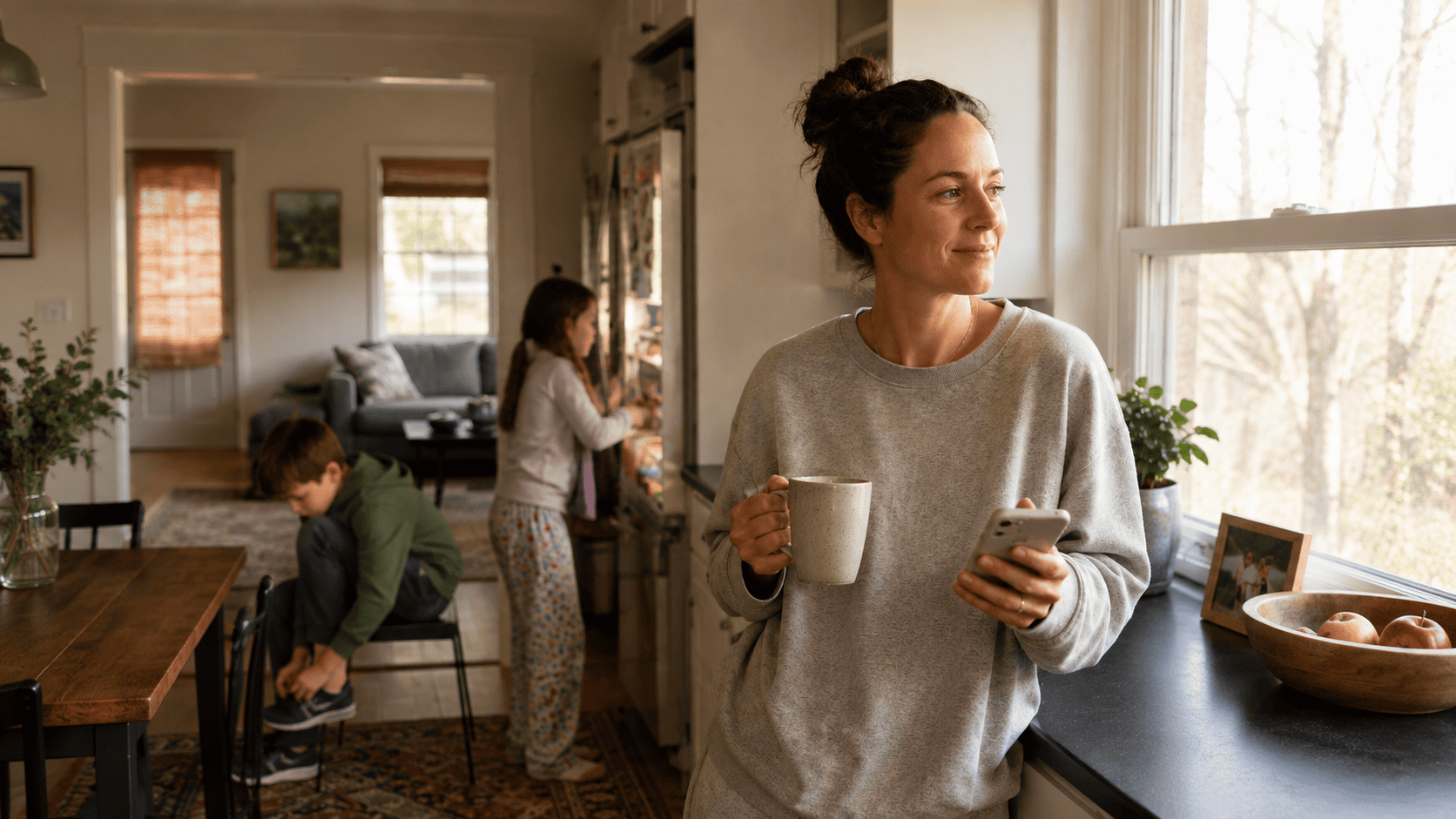
Whatever your answer is, you don't have to carry the whole load alone.
FAQ
What is a beta mom?
A beta mom is a high-achieving mother who is intentionally stepping back from the most intensive, perfectionist style of parenting that has dominated the past three decades. Beta mothering means dropping the activities, expectations, and invisible labor that don't actually serve her family, and protecting time for relationships, rest, and the things that do.
What's the difference between a beta mom and a tiger mom?
A tiger mom, a term made famous by Amy Chua's 2011 book Battle Hymn of the Tiger Mother, emphasizes high standards, structured involvement, and active investment in her child's future. A beta mom takes a different approach: more autonomy for the kids, less over-scheduling, and a refusal to treat parenting as a competitive sport. Both styles aim at thriving children, they just differ on what thriving requires. Many modern mothers move between the two depending on the child, the day, and the situation.
What's a Type B mom or Type C mom?
"Type B mom" is the TikTok-popular version of the same idea, a mom who's chosen to opt out of Type A perfectionism. "Type C," coined by content creator Ashleigh Surratt, is a hybrid approach: caring intensely about a few things and deliberately letting go of the rest. Beta, Type B, and Type C all describe variations of the same broader cultural shift toward giving mothers more permission to define what works for their family.
Is beta mothering bad for kids?
There is no evidence that less-intensive parenting harms children, and considerable evidence that it can benefit them, particularly around autonomy, creativity, and self-regulation. Parental wellbeing is also one of the most reliable predictors of child wellbeing. That said, every child is different, and many children thrive in more structured environments. The "right" approach depends on the child, the family, and the goals, not on a one-size-fits-all parenting philosophy.
Why is beta mothering becoming popular now?
Three converging shifts. First, the cultural conversation about maternal mental health and burnout, including new research on cognitive labor from sociologist Allison Daminger, has made the cost of intensive mothering impossible to ignore. Second, time-use data shows mothers are now spending nearly five times as much time on activities like homework help as they did in 1975, while also working at record rates (maternal labor force participation hit 74% between 2023 and 2025). The math has stopped working. Third, AI and a shifting labor market are broadening the conversation about what "preparing your kids for the future" actually requires.
How do I figure out what kind of mom I want to be?
Start with what matters to your family, not what the culture around you says should matter. Some questions to sit with: which activities and expectations are you carrying out of habit rather than conviction? Which ones genuinely serve your kids? Which ones are draining you in ways that aren't worth the return? You don't have to choose a label. You just have to choose deliberately.
What can I outsource as a parent?
More than you think. Meal planning, calendar coordination, household to-dos, reminders, scheduling. All of this can be delegated to partners, kids themselves, services, or tools like Ohai. The goal is to move the cognitive load out of your head so the time and attention you do spend with your family is undistracted, regardless of which parenting style fits you best.