Do I Have ADHD, or Am I Just an Overwhelmed Mom?

Table of Contents
Lately, we've been hearing this question from moms more and more. Here is a look at the difference, why so many women are asking it right now, and what actually helps either way.
If you have ever sat in the car after school pickup wondering whether your scattered brain is a medical thing or just the reality of motherhood, you are in good company. In our conversations with users at Ohai, this exact question comes up again and again, almost word for word: "I genuinely cannot tell if I have ADHD, or if I am just a mom who is completely overwhelmed."
It is a fair question, and it deserves a real answer. Not a 10-question quiz that conveniently ends with a button to download an app. So let us talk about it honestly.
Before we get into it, one important note: we build a household manager, not a diagnostic tool. We'll be clear about where that line sits and point you toward the people who can answer the medical questions. But after talking to hundreds of parents about overwhelm, there are some patterns worth exploring.
The simplest answer: Situational overwhelm and ADHD can look almost identical from the outside, but they usually differ in two big ways. ADHD is a lifelong neurodevelopmental condition (although symptoms and their impact can change throughout different stages of life), while situational overwhelm tends to be newer, tied to a specific season or stressor, and it eases when the pressure lets up. The catch is that they overlap heavily, they can exist at the same time, and motherhood can unmask ADHD that was always quietly there. Only a qualified clinician can diagnose ADHD. If the chaos is genuinely affecting your daily life, an evaluation is worth it no matter which way it turns out.
Why so many moms are asking this question right now
This is not a question moms used to ask out loud. Now it is everywhere, and there are real reasons for that.
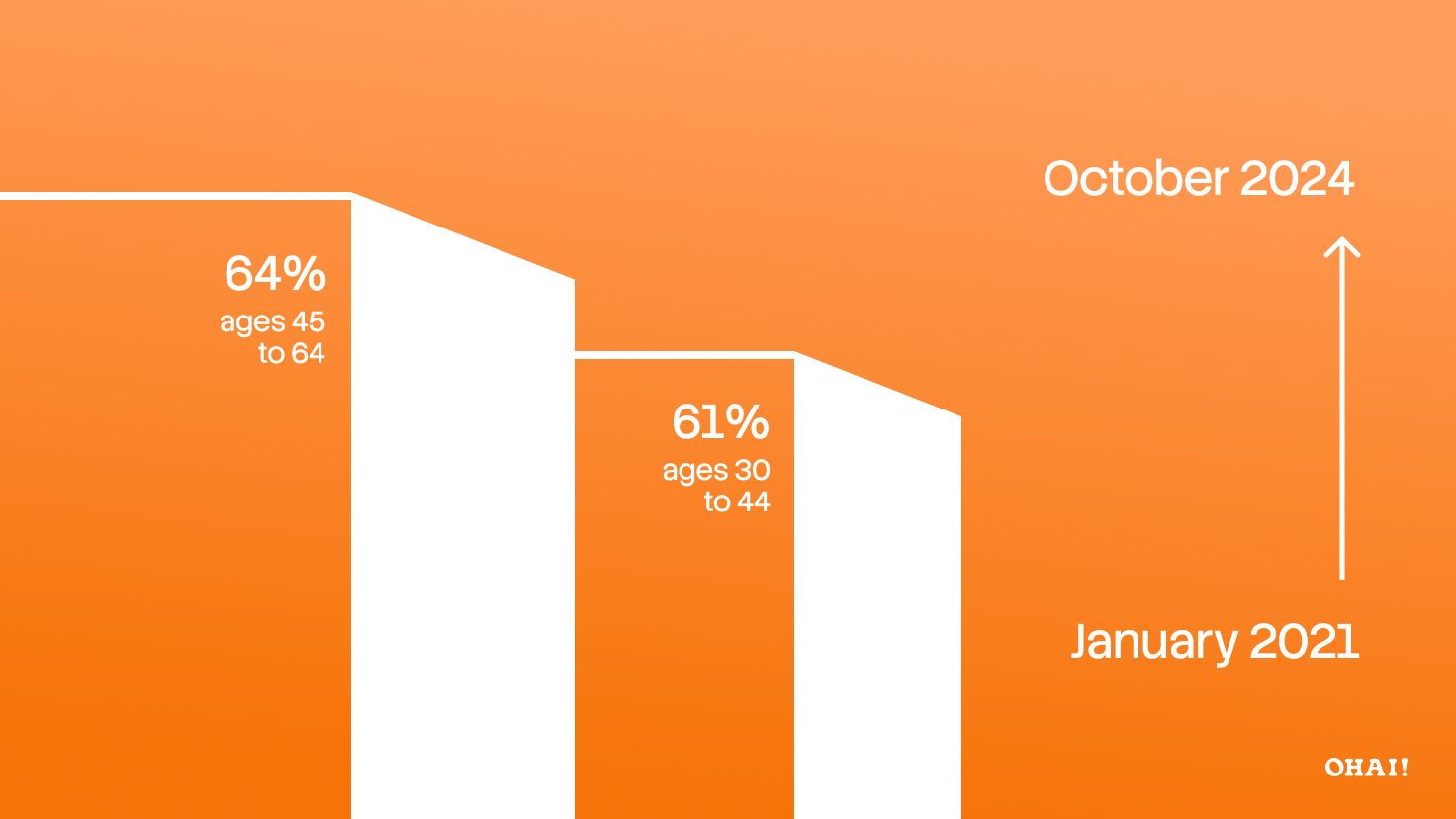
Adult ADHD diagnoses have climbed sharply in the last few years. Yale Medicine, drawing on data from the health analytics company Truveta, reports that diagnoses in adults over 30 rose by roughly 61 percent in people aged 30 to 44 and about 64 percent in those aged 45 to 64 between early 2021 and late 2024. A Yale psychiatrist quoted in that piece noted she sees the increase especially among middle-aged parents, and points to the always-on, high-demand lifestyle many of us live as one likely factor.
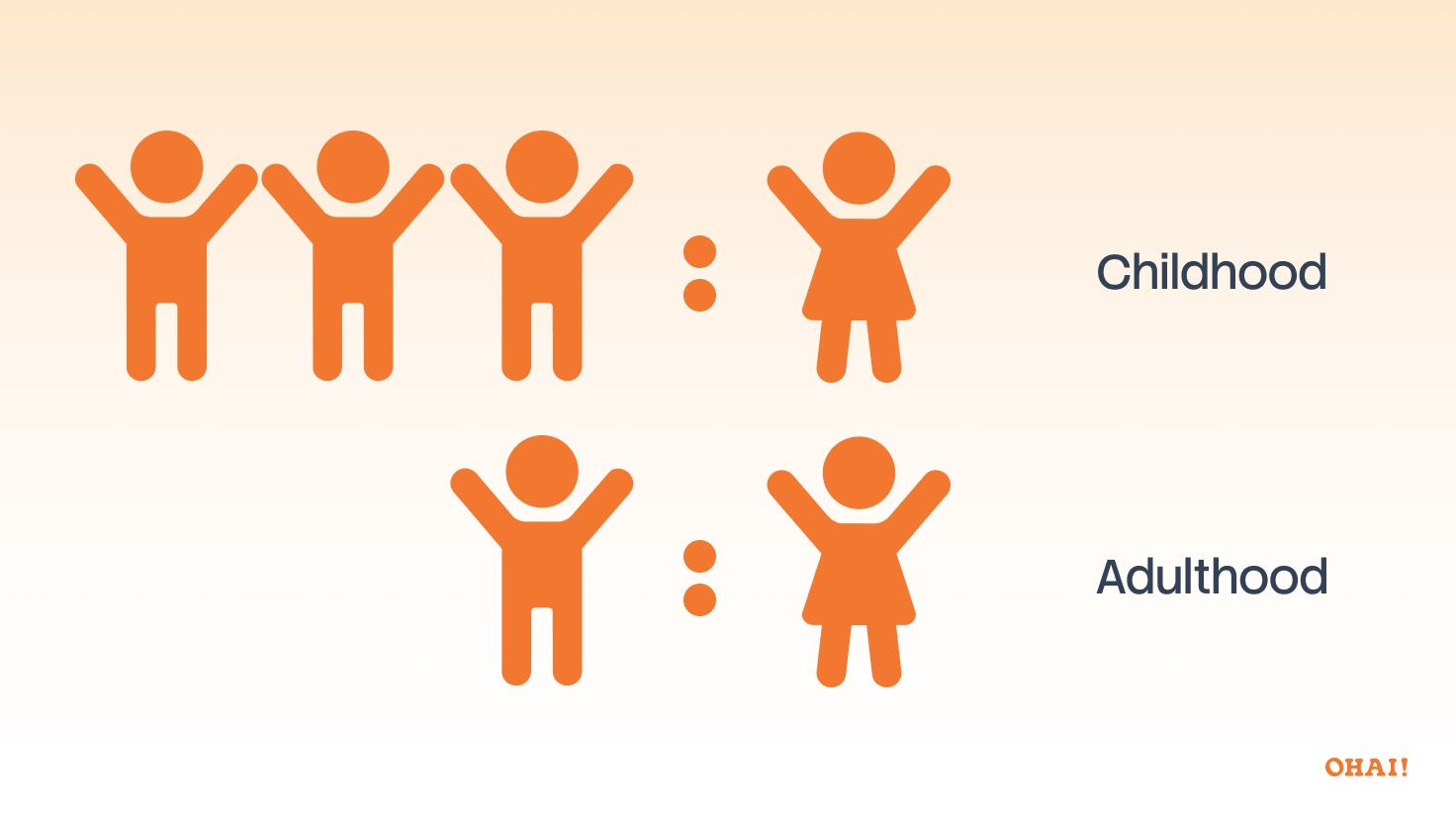
There is also a long-standing gap in who gets diagnosed in the first place. According to the Cleveland Clinic, ADHD is identified in boys far more often than girls in childhood, often cited at a ratio of around three to one, but that gap narrows to roughly one to one by adulthood. Women do not suddenly develop ADHD at 38. Many of them had it all along and were simply overlooked. Understood.org, one of the most trusted resources for neurodivergent people, describes this as "the lost generation" of women whose ADHD was missed in childhood and only surfaces now.
And here is the pattern we find most striking, because it shows up in our user interviews too. Henry Ford Health describes a common "lightbulb moment": a woman takes her child in to be evaluated, recognizes herself in the symptoms, and realizes she may have been quietly struggling for decades. The question is not coming out of nowhere. It is often coming from the pediatrician's office.
Layer on top of that the hormonal piece. Researchers believe hormonal shifts during pregnancy, postpartum, and perimenopause may influence attention, focus, and ADHD symptoms in some women. As Mission Connection and maternal-health resources like Momwell point out, many women notice their symptoms shift during pregnancy, postpartum, and perimenopause. So a mom in the thick of young kids and hormonal change can experience a very real spike in forgetfulness and overwhelm, which makes the "is this me or is this ADHD" question even harder to untangle.
In other words: if you are asking this, you are not being dramatic, and you are not the only one. You are part of a very large group of women asking it at the same time.
ADHD vs. situational overwhelm: what is actually different
The challenge is burnout, anxiety, depression, and ADHD can all look similar on the surface. Tired, foggy, forgetful, short-tempered, behind on everything. Clinicians who write about this, from Talkspace to the Attention Deficit Disorder Association, stress that these conditions overlap a lot and often travel together.
That said, there are a few patterns that tend to separate lifelong ADHD from situational overwhelm. Think of these as clues, not verdicts.
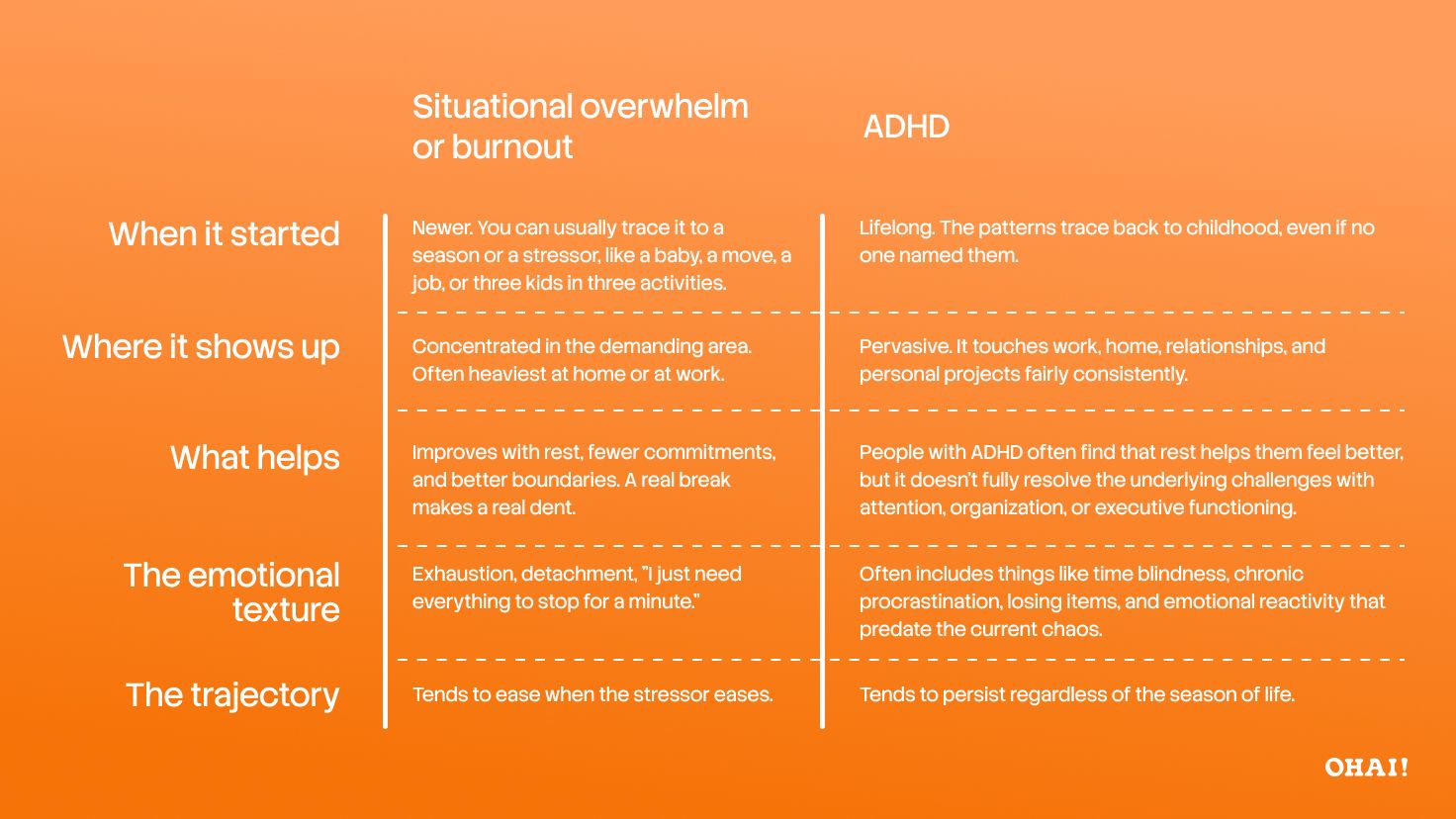
A few sources sum the distinction up cleanly. Practices like Renewing Mindsets and Dayspring describe burnout as situational and progressive, something that builds from sustained stress and improves with recovery, while ADHD is a neurodevelopmental condition that affects executive functioning, does not appear out of nowhere in adulthood, and shows up across the whole of your life rather than in one corner of it.
The single most useful question to sit with is this: if the pressure of this exact season magically lifted, would the forgetfulness and scatter mostly lift with it? If yes, that points more toward overwhelm. If you suspect the scatter would still be there because it has always been there, that points toward something worth evaluating.
Why overwhelmed moms in particular get missed
There are a few reasons so many women reach motherhood without ever being assessed.
The classic picture was built around boys. The stereotype of ADHD is a hyperactive kid bouncing off the walls. Many women have the inattentive presentation instead: daydreaming, zoning out, losing track of time, struggling with organization. It is quieter, so it gets overlooked. Cleveland Clinic and others note this is a major driver of underdiagnosis in women.
Masking is rewarded. Henry Ford Health describes how women with undiagnosed ADHD often build elaborate coping systems, work late into the night to keep up, and push through, which hides the struggle from everyone but themselves. The to-do list looks handled. The cost is invisible.
It gets misread as something else. In adulthood, women's ADHD symptoms are frequently attributed to anxiety, depression, or "just being stressed," as Mission Connection points out. Sometimes the secondary condition gets treated for years while the underlying cause goes unaddressed.
The mental load is genuinely enormous. Even without ADHD, the invisible labor of running a household is a real cognitive load: every appointment, permission slip, snack rotation, and birthday gift lives in one person's head. When that mental load is already maxed out, the difference between "overloaded" and "neurodivergent" becomes very hard to feel from the inside.
None of this means every overwhelmed mom has ADHD. Plenty of overwhelm is just overwhelm, and it is a completely rational response to an unreasonable amount of logistics. The point is simply that being missed for years is common, and noticing it now is not paranoia.

A blog cannot diagnose you
We need to be direct about this, because the topic is sensitive and the stakes are personal.
Nothing in this article can tell you whether you have ADHD. The patterns above are starting points for a conversation, not a checklist that produces a result. ADHD is diagnosed by a qualified professional, usually through a clinical interview, history, and validated tools.
There are self-report screeners out there, like the Adult ADHD Self-Report Scale, that some clinicians use. It is worth understanding that these are screeners, not diagnoses. They can help you decide whether to seek an evaluation. They cannot replace one.
So when is it worth booking that evaluation? A reasonable rule of thumb: if focus, organization, or overwhelm is consistently interfering with your work, your relationships, or your sense of yourself, and especially if it predates your current season of life, talk to a professional.
Where to get evaluated for ADHD in the US
If you are in the US and want to take the next step, here is a practical map of where to start. None of these is a paid endorsement, just the resources women in our community have found most useful.
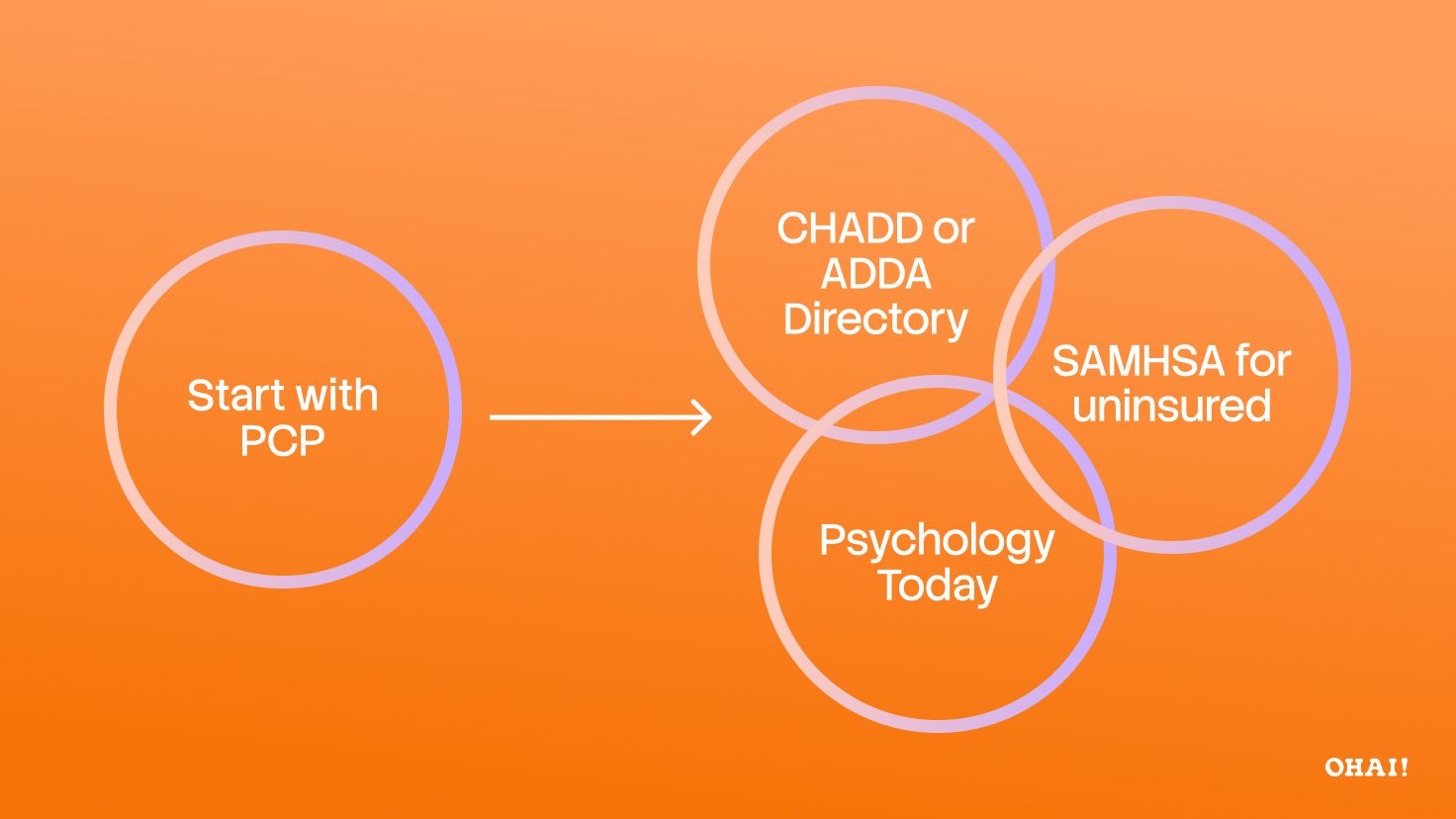
Start with your primary care doctor. This is the simplest first move. Your PCP can do an initial screen, rule out other things that mimic ADHD (like thyroid issues or sleep apnea), and refer you to a specialist who diagnoses adult ADHD. If you have insurance, this is usually the fastest covered path.
CHADD's Professional Directory is the national database from Children and Adults with ADHD, the leading US nonprofit on this. You can search by state for psychologists, psychiatrists, and coaches who specialize in ADHD. CHADD also has a helpful guide to which professionals can actually diagnose and treat ADHD, since the answer is not always obvious.
ADDA (Attention Deficit Disorder Association) maintains an adult-focused directory of clinicians and coaches and is specifically oriented toward adults, which CHADD complements with a more family-wide scope.
Psychology Today's therapist directory lets you filter by ADHD specialty, insurance, and location, and is one of the most commonly used ways to find a clinician who actually takes your plan.
Understood.org is a free, deeply trusted resource for neurodivergent people and families. Their articles on women, motherhood, and adult ADHD are a good starting place if you want to learn more before booking an appointment.
SAMHSA's National Helpline, at 1-800-662-4357, is a free, confidential 24/7 service that can help you find local mental health resources, including options if you do not have insurance. Community mental health centers often offer sliding-scale evaluations.
Whichever route you choose, two practical tips: ask up front whether the clinician specifically evaluates adult women for ADHD (some still mainly see children, and the presentation is different), and ask whether they will be the one providing ongoing care or referring you elsewhere if diagnosed. Both questions save a lot of time.
If what you are feeling is closer to persistent sadness, hopelessness, or loss of interest, that points toward depression rather than ADHD or burnout, and it is also very much worth raising with a clinician. Getting the right answer matters because the right answer changes what helps. Treating burnout like ADHD, or ADHD like burnout, can mean years of strategies that never quite fit. Clarity is not about putting a label on yourself. It is about finally getting support that actually matches what is going on.
This is a sensitive subject, and if any of this is bringing up something heavier for you, please reach out to a doctor or a mental health professional you trust. You deserve real support.
What helps, whether it is ADHD, overwhelm, or both
The encouraging part is that while diagnosis changes the treatment path, one core strategy helps across the board, and it is the same advice ADHD coaches give their clients and the same advice burnout specialists give theirs: stop storing your entire life in your own head.
Clinicians call this externalizing. The idea is that working memory is a terrible place to keep a household. Every date, task, and reminder you try to hold in your mind is taking up bandwidth and quietly draining you. Get it out of your head and into a trusted system, and your brain finally has room to breathe. This is foundational for people with ADHD, whose executive function is already stretched, and it is a relief for anyone carrying a heavy mental load.
A few practical ways to do that:
Start with a daily brain dump. Every evening (or every morning, whichever sticks for you) take five minutes to empty everything onto one surface. Every errand, appointment, worry, and half-remembered "oh, I need to..." goes down in one place. Do it by voice if writing feels like one more task. The goal is not to organize it yet. The goal is to get it out. A daily brain dump is the single fastest way to feel less scattered, because the scatter is largely the result of trying to remember too much at once.
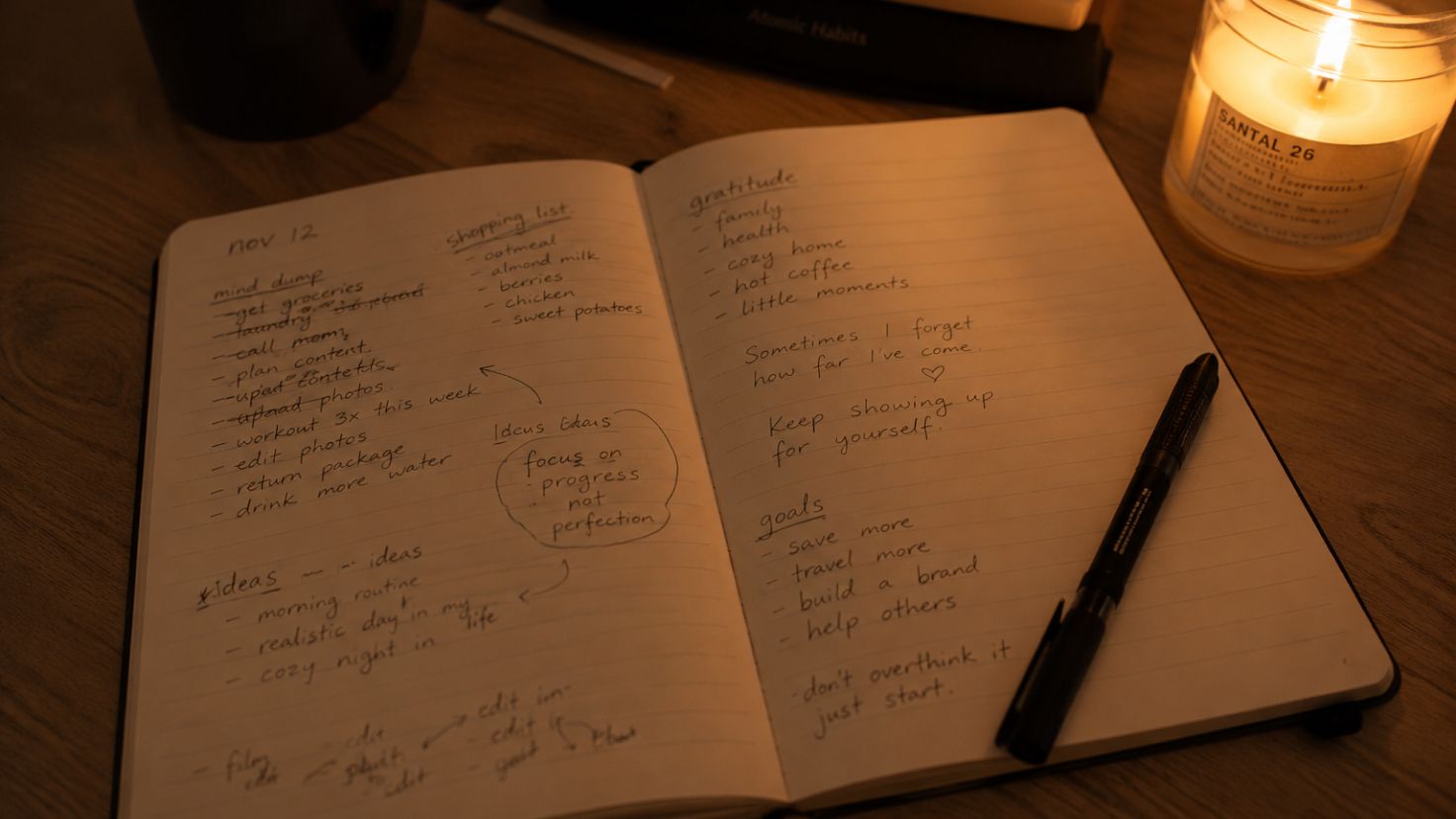
Turn the dump into a system, not just a longer list. A pile of tasks on paper still lives or dies on you remembering to look at it. The real win is moving each item into something that will remind you at the right moment: a calendar event, a shared list, or a scheduled nudge. The point is that the follow-through does not depend on your memory anymore.
Break big things into smaller things. "Plan birthday party" is not a task, it is a project. So is "get the kids ready for summer" and "switch pediatricians." For a brain that is already over capacity, vague megatasks are paralyzing, which is why they sit on the list for weeks. The fix is to break them into the smallest concrete next step: "text Sara to ask about the party venue," "call insurance about pediatrician network." Understood.org calls this one of the most reliable executive-function strategies for ADHD, but it works for any overloaded brain.
Build one repeatable reset. A lot of moms swear by a Sunday reset, a short weekly ritual to look at the week ahead, spot the conflicts, and get ahead of them before Monday hits. It does not need to be aesthetic or two hours long. Fifteen minutes of asking yourself (or Ohai) "what are my upcoming schedule conflicts this week" prevents most of the week's fire drills.
Use recurring reminders for the things that keep slipping. If you keep forgetting the same recurring thing, whether it is medication, water, or the laundry cycle, a simple recurring reminder or recurring to-do removes the daily decision. Good habit tracker ideas for busy parents tend to be small and boring on purpose: the boring ones are the ones that stick.
Get scheduling conflicts out of your blind spot. A huge amount of overwhelm is really just hidden collisions. Two kids, two activities, one of you, same 4pm. When everyone's commitments live in separate places, a scheduling conflict only reveals itself when it is already a crisis. Putting every calendar in one shared view is what turns "how did I not see this coming" into "spotted it, and sorted it out last Sunday."
Share the load on purpose, including with the kids. The mental load problem is partly a one-person-holds-everything problem. Making the household's tasks and calendar visible to a partner or co-parent means responsibilities can actually be shared, instead of one person quietly running air traffic control for the whole family. And the same goes for the kids. Age-appropriate chores and visible to-dos shift kids from "things that get done for them" to "things they own," which is genuinely good for them and gives you back time and attention. A 9-year-old can absolutely be in charge of feeding the dog and packing their own water bottle, if the system reminds them instead of you.
Notice that none of this requires you to become a more disciplined person. That is the entire point. The systems that work are the ones that work even on your worst, most distracted, most overwhelmed day.
Where Ohai fits in
Let's be clear about where Ohai fits. Ohai is not a treatment, and it will not tell you whether you have ADHD. What it does is one specific thing very well: it is the external place to put your household so you are not holding all of it in your head.
Ohai is an AI household manager you talk to like a person, by text, voice, web chat, or the app. You hand it the mental load and it holds it for you. That maps almost exactly onto the "externalize your brain" strategy above.
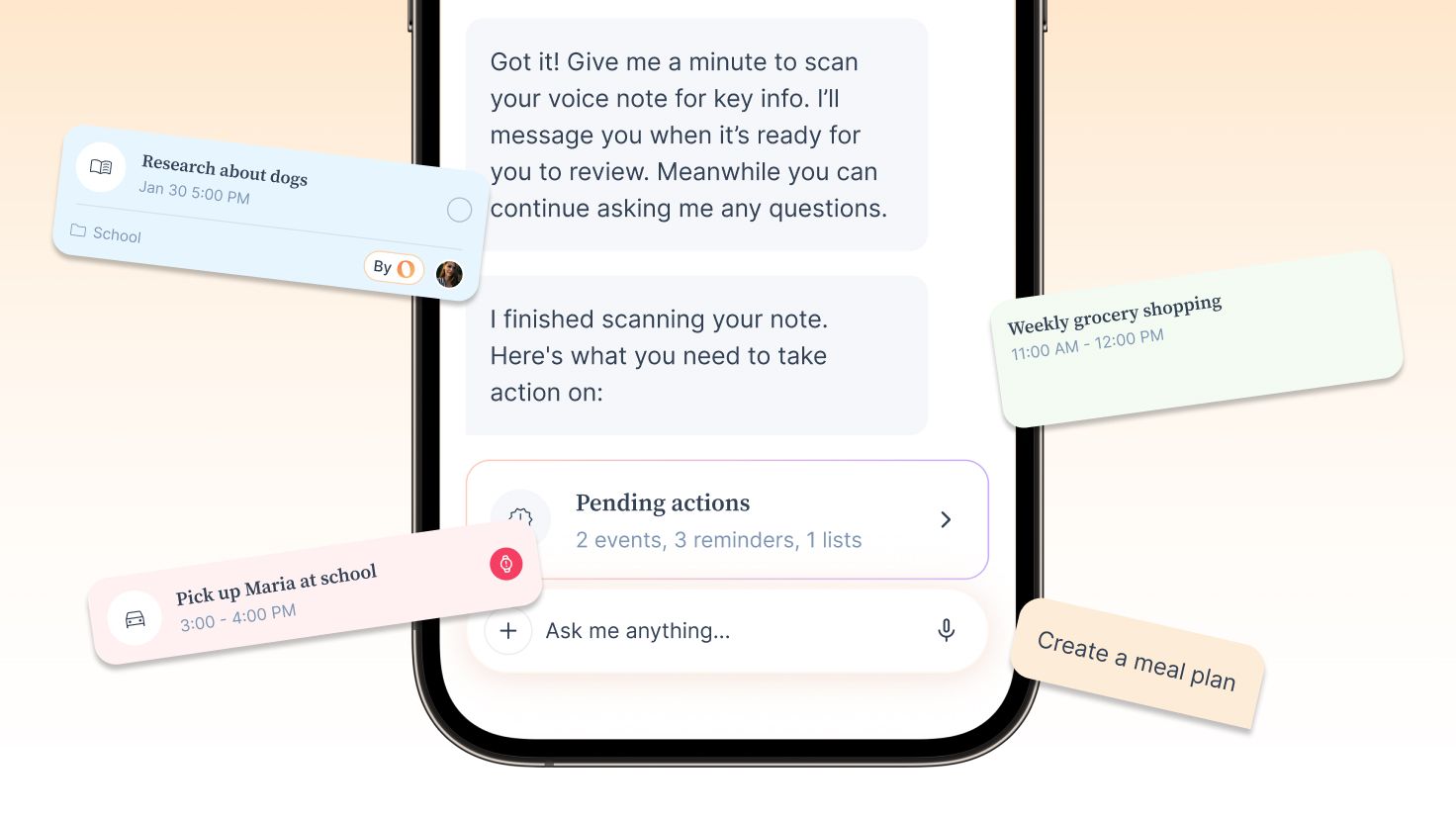
Over the last several months, our users with ADHD have been sharing with us how they use Ohai day to day. These examples come from conversations; they are personal experiences, not clinical findings:
They call it their "external brain." One mom whose whole household lives with ADHD described Ohai as her "common repository for life." She and her husband both have ADHD, and what works for them is that everything lives in one place neither of them has to remember.
They send things to O the moment they pop into their head. One user, who described his executive dysfunction as severe, called Ohai a lifesaver because he can fire off whatever just occurred to him, and trust it will be scheduled, reminded, or added to a list before he forgets it ninety seconds later. This is one of the most repeated patterns we hear. ADHD brains and overwhelmed brains are both very good at remembering things at the wrong moment, like in the shower, in the car, at 11pm. A quick text or voice note to O turns those flashes into actual follow-through.
They use it for daily medication reminders. Another mom with ADHD told us she keeps forgetting to take her medication and to add appointments to her calendar. Recurring reminders for the medication, and doc scanning for appointment cards and Facebook event screenshots, are her two anchors.
They use it to nudge family members without nagging. One mom with a teenage daughter who has ADHD said Ohai changed how she parents. Instead of being the human reminder service, she sets up O to send the reminders directly to her daughter. It is the same information, but it does not feel like micromanagement, which matters a lot when you are raising a teenager with ADHD.
They ask O to break big things down. Several users mentioned using O to take a vague overwhelming task ("plan summer," "organize the playroom") and split it into smaller, actually-doable next steps, then drop those into the calendar.
They use doc scanning instead of trying to organize on paper. One mom photographs her own handwritten notes and sends them to O, who pulls out the tasks and dates and turns them into a plan for the week. It is faster than retyping, and the to-do list ends up somewhere she will actually see it.
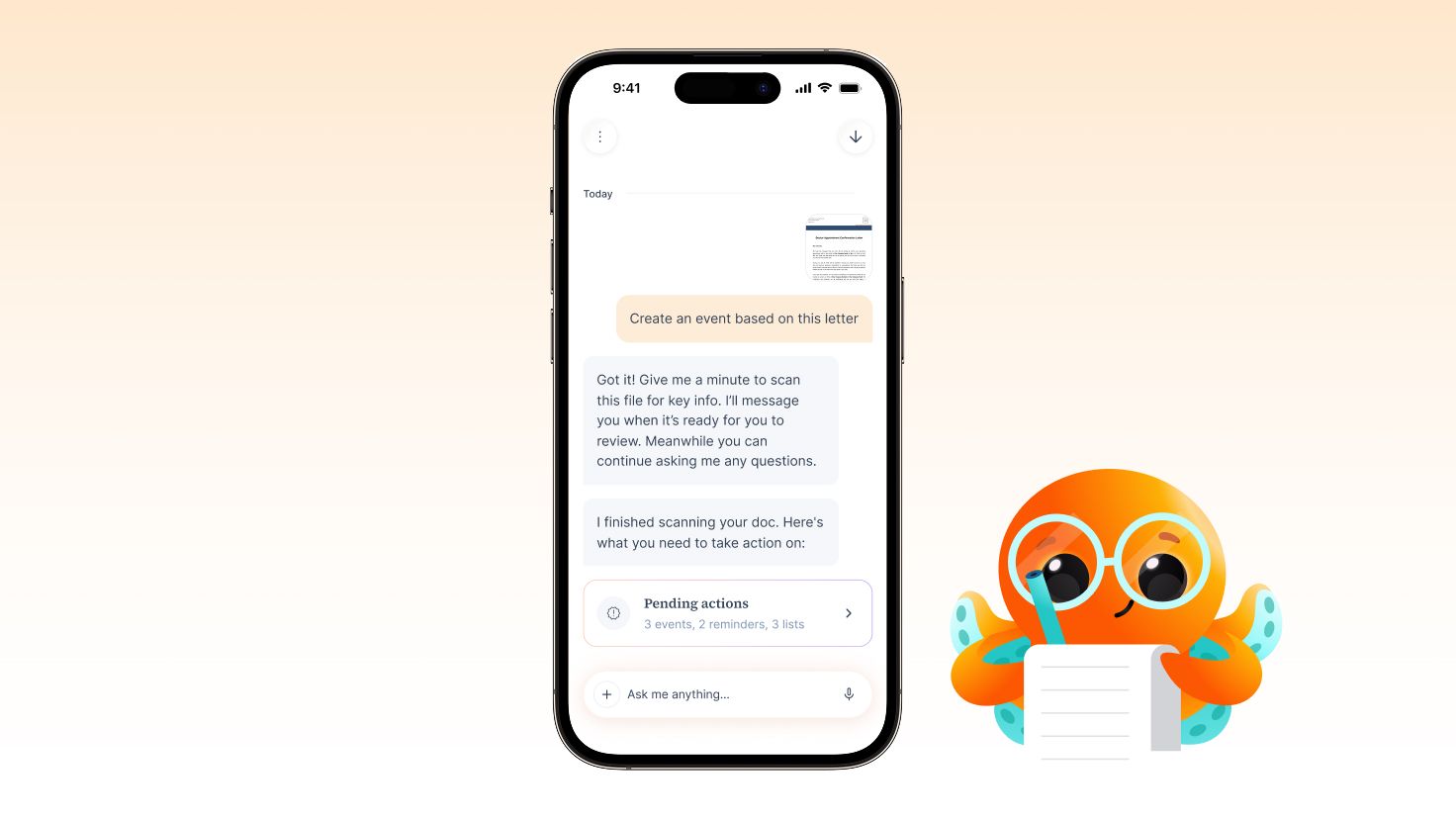
Here are some of the features our neurodivergent users tell us they rely on most:
Brain dump by text or voice, any time. You can talk to O like a person and offload whatever is in your head, even when it comes out as a messy stream. O sorts it into reminders, events, Lists, and to-dos.
Quick capture for things you will otherwise forget. Tell O the moment you remember it, by text or by voice, and trust it is held. This is the use case our ADHD users mention most.
To-dos that recur, and big tasks that break down. Recurring to-dos handle the things you keep forgetting on the same cadence. For bigger projects, you can ask O to break them into smaller steps and put those steps onto specific days.
Documents and emails turned into action. Forward a school newsletter to use email scanning, snap a photo of a handwritten note or sports schedule, and O pulls out the dates and offers to add them. The paperwork stops living on the fridge and in your memory.
Reminders that go to whoever needs them. O can nudge you, your partner, or your kid, by text or in the app, even if the other person does not have the app.
A shared Circle so the load is actually shared. Add a partner, co-parent, or older kid so the calendar, Lists, and reminders are visible to everyone, not stuck in one head.
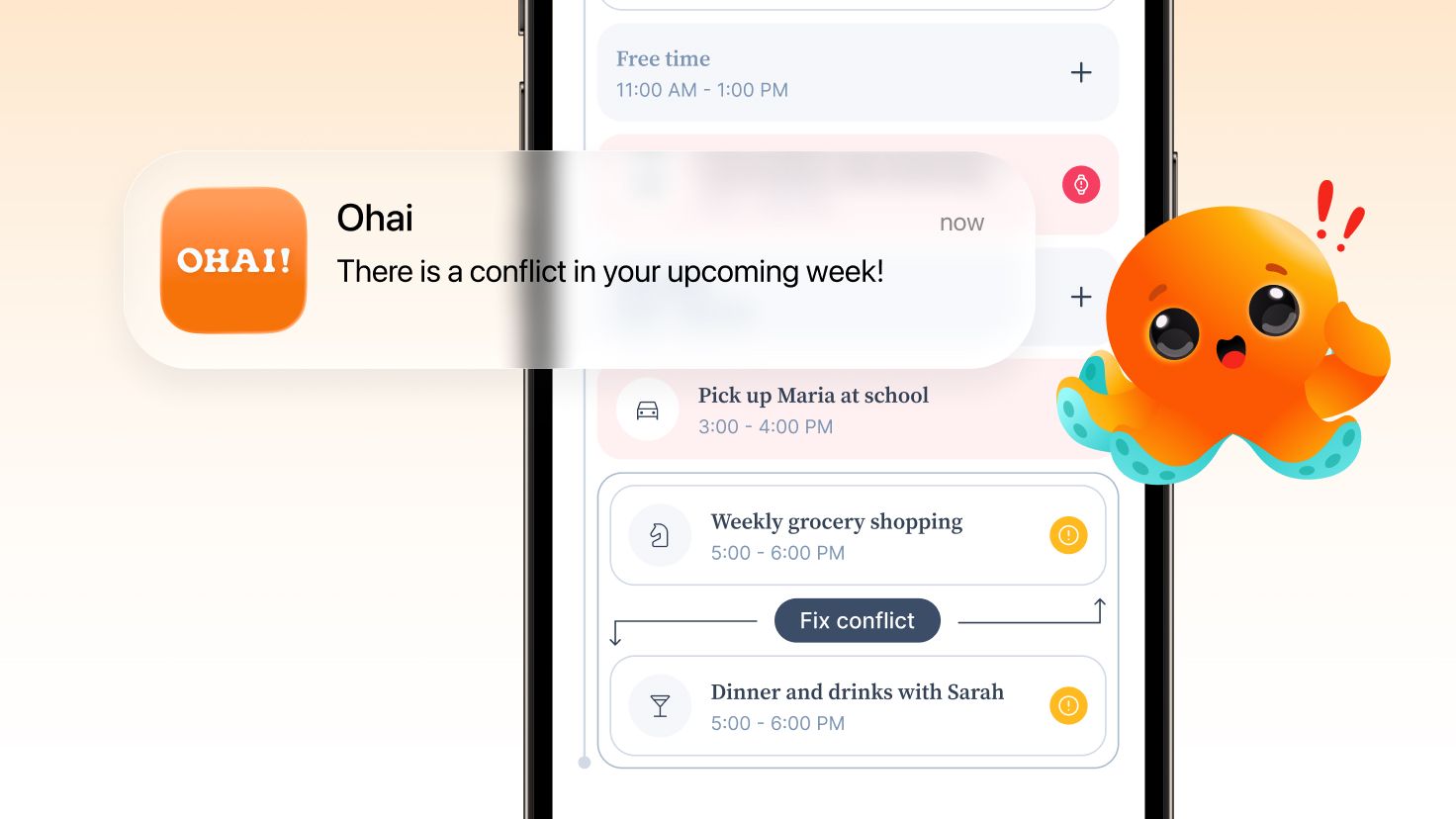
Daily and weekly Pings. A short morning rundown of what is on your plate, an evening heads-up on tomorrow, and a weekly Ping that walks you through the week ahead, including your meal plan, so you can spot and fix conflicts before the week starts.
One view across every calendar. Connect Google, Apple, and Outlook, and O looks across all of them through one shared family calendar. When you try to add a new event, O checks for scheduling conflicts in advance, flags the overlap, and gives you the chance to fix it before it becomes a 4pm scramble.
If you do get an ADHD diagnosis, the externalizing strategy O supports is exactly what coaches recommend building your days around. And if it turns out you are simply an overwhelmed mom carrying too much, the same support takes the weight off. Either way, you end up with a quieter head. That is the part that helps no matter the answer.
Frequently asked questions
Is being an overwhelmed mom the same as having ADHD?
No. Overwhelm is a situational response to too much load and it usually eases when the pressure does. ADHD is a lifelong, neurodevelopmental condition that affects focus, organization, and impulse control across all areas of life. They can look similar and often overlap, and motherhood can reveal ADHD that was always there, but they are not the same thing and only a clinician can diagnose ADHD.
Why do so many women get diagnosed with ADHD as moms?
Many women were overlooked as girls because their symptoms were quieter and inattentive rather than hyperactive. The "aha" often comes in motherhood, frequently when a child is being evaluated and the parent recognizes herself, and hormonal changes around postpartum and perimenopause can intensify symptoms that were previously manageable.
How do I know if it is ADHD or just burnout?
A useful test is whether the struggle is lifelong and everywhere, or recent and tied to a specific stressor. Burnout tends to improve with rest and fewer commitments, while ADHD persists even after a real break and traces back to childhood. Because they overlap, the most reliable way to know is a professional evaluation.
Where can I get evaluated for ADHD in the US?
Start with your primary care doctor for a referral, or search the CHADD Professional Directory, the ADDA directory, or Psychology Today's therapist finder for a clinician who specializes in adult ADHD. If you do not have insurance, the SAMHSA helpline at 1-800-662-4357 can point you to local community mental health centers, many of which offer sliding-scale evaluations.
Can a quiz or an app diagnose ADHD?
No. Self-report tools are screeners that can help you decide whether to seek an assessment, but they cannot diagnose you. A qualified clinician makes the diagnosis through history and validated assessments. If symptoms are interfering with your daily life, that is the signal to book an evaluation.
What is a brain dump and does it actually help?
A brain dump is the practice of getting every task, worry, and reminder out of your head and into one place at once. It helps because much of the feeling of being scattered comes from trying to hold too much in working memory. The bigger win comes when you move those items into a system that reminds you later, so follow-through no longer depends on your memory. An AI assistant app like Ohai can do this from a single text or voice note.
What is the best AI personal assistant for an overwhelmed mom?
The most useful AI personal assistant for a busy parent is one that holds the whole household, not just your work calendar. Look for an AI assistant that combines calendar management across family members, reminders, shared Lists, to-dos, document and email scanning, and a way to share the load with a partner or older children. Ohai is an AI household manager built specifically for family logistics, accessible by text, voice, web, or app.
Can an AI scheduling assistant prevent scheduling conflicts?
Yes. An AI scheduling assistant or AI calendar assistant that syncs everyone's calendars into one shared view can flag overlapping events before they become a problem and suggest alternatives. Most scheduling conflicts in a household come from commitments living in separate places, so the fix is putting them in one place that watches for collisions on your behalf.
Does Ohai help people with ADHD?
Ohai is not a treatment for ADHD and does not diagnose it. That said, many of our ADHD users describe Ohai as their "external brain," and the things they use it for, daily brain dumps by voice, quick capture before they forget, recurring medication reminders, breaking big tasks into smaller ones, doc scanning instead of paper organization, and shared reminders for the family, line up closely with the executive-function strategies ADHD coaches recommend.
Will offloading my to-do list reduce my mental load?
For most people, yes. The mental load is largely the cognitive cost of remembering and tracking everything yourself. Moving that into a trusted system, and sharing it with your household, is the same strategy clinicians recommend for ADHD and the same one that relieves ordinary overwhelm. It frees up attention regardless of the underlying cause.
You do not have to carry all of it in your head
Whether the answer is ADHD, overwhelm, or some combination of both, the next step is often the same: stop carrying everything in your head. If the struggle is affecting daily life, talk to a clinician. For the logistics, build a system you can trust.
Try Ohai free and let O carry the mental load with you.
This article is for general informational purposes and is not medical advice. It cannot diagnose ADHD or any other condition. If you are concerned about your focus, mood, or wellbeing, please consult a qualified healthcare professional.
Sources informing this article include Yale Medicine, Cleveland Clinic, Henry Ford Health, Understood.org, Mission Connection, Momwell, Talkspace, CHADD, ADDA, and peer-reviewed research on late-diagnosed ADHD in women.